When do we stop NPWT, and what comes next?
Content note. The video shows real clinical wound photos from a clinician-reported case, shared with permission. They appear after a warning screen. The written guide below has no photos.
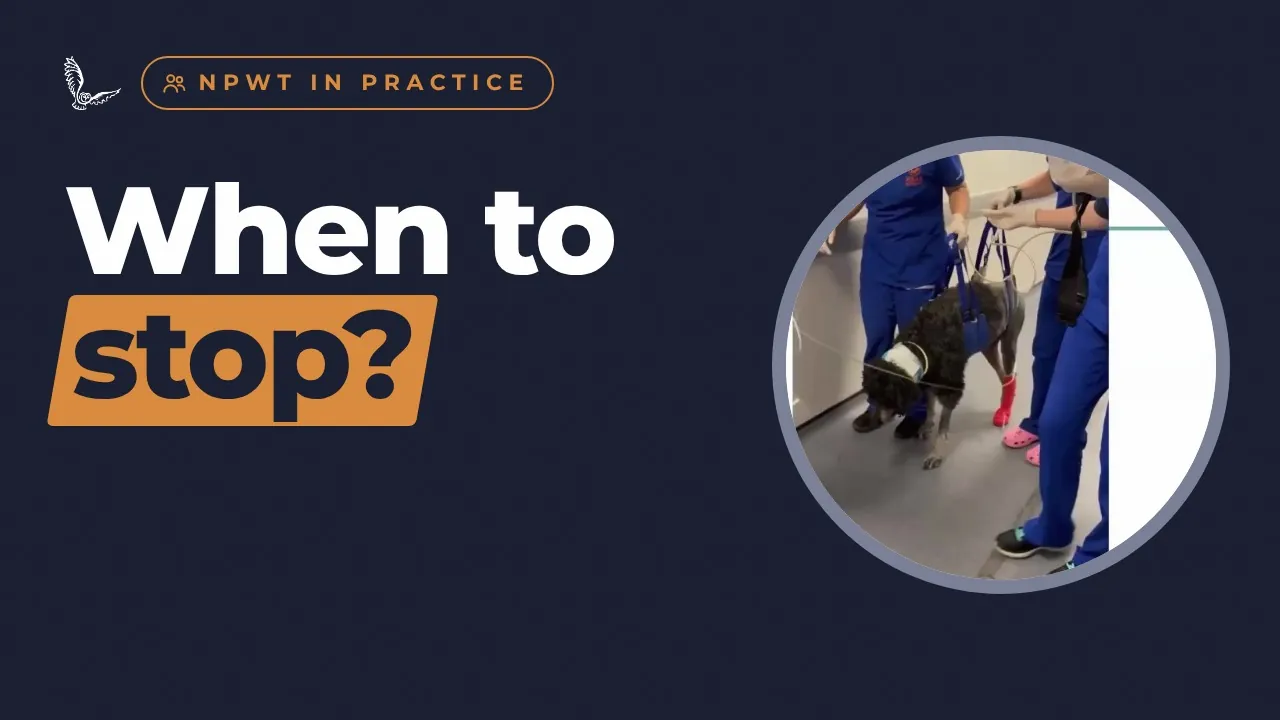
How vet teams decide when to stop negative pressure wound therapy (NPWT), and the two routes that follow: closing the wound, or letting it heal by second intention. Following clinician-reported case 007, a carpal wound managed by Cumath Pet Surgeons. For vet teams. Contains wound photos.
Three things to remember
- Stop when the wound bed is ready.
- Close it, or let it heal.
- Hand over with a plan.
The full episode, written out
This is the narration from the video, so you can read it at your own pace, share it, or come back to a section.
Introduction
Welcome to Aluco Health. I'm Georgie Hollis. This is NPWT in Practice. NPWT is a step in a wound's journey, not the destination. So how do you know when to stop, and what comes next? We'll follow a real case all the way through.
A step, not the destination
In a published study of forty-five dogs, the usual time on NPWT was just three days. NPWT prepares the wound. Then something else finishes the job: surgery to close it, or ordinary dressings while it heals on its own. Knowing when to switch matters.
Jargon buster: second intention
One phrase to know: second intention. It means letting a wound heal on its own, filling from the bottom up and closing from the edges in, without stitching it closed.
Signs it may be time
So what are the signs? In the published study, NPWT was stopped once a smooth granulation bed with a good blood supply had formed. Before a wound is closed, it should be free of dead tissue, debris and infection. Falling fluid volume in the canister can be a sign of progress. And most importantly, the goal you set at the start has been met.
Other reasons to stop
There are other reasons to stop, too. The manual advises against using the dressing kit continually for more than thirty days. Stop and reassess if there's spreading infection or bleeding; the manual warns that negative pressure can make bleeding worse. And if the wound isn't progressing, rethink the plan with your surgeon.
What comes next
When you stop, there are two main routes. Close the wound, with stitches, a flap or a graft, sometimes with a drain to manage the space underneath; two of our case reports used one. Or let it heal by second intention, with non-stick dressings and a bandage. In the published study, about three in five wounds were closed surgically, and about a third healed on their own.
Case 007
Here's the case. A large-breed dog had a wound over the front of the carpus, thought to be a burst abscess. A biopsy found no sign of tumour spread. Because the area moves so much, closing it straight away would have put it under a lot of tension. So the team clipped widely, debrided and cleaned it under anaesthesia, and applied NPWT at a hundred and twenty millimetres of mercury, enclosing the whole foot in the film to get a complete seal.
Six days, two dressings
The dressing stayed on for three days, with the patient kept in so the team could make sure the pressure held. The foam was replaced at three days. There were no complications, and the patient stayed comfortable. By six days, the wound had shrunk a lot, with a healthy edge of new skin forming.
Case 007 at six days
So which route? The team chose the second. With a healthy wound bed, and the edges healing, they stopped NPWT and discharged the patient with a foam dressing and a standard limb bandage, to finish healing at home.
What happened next
At the check-up a week later, the wound had shrunk further, with no problems, and no interference from the patient. After just two NPWT applications, the wound had reduced to less than half its original size. It's one clinician-reported case, not proof, but it shows NPWT doing its job: preparing the wound, then handing over to ordinary care.
Handing over
Whichever route you take, hand over properly. Write a clear plan: the closure, or the dressings and how often they're changed. Use a non-stick contact layer to protect the new tissue. Book check-ups, and keep measuring and photographing the wound. And brief the owner on what to watch for at home.
Words explained
- Second intention
- Letting a wound heal on its own, without stitching it closed.
- Granulation tissue
- Healthy red tissue that fills a wound as it heals.
- Carpus
- The wrist joint of the front leg.
Sources
- S1Pitt KA, Stanley BJ. Negative pressure wound therapy: experience in 45 dogs. Vet Surg 2014;43(4):380–387. doi:10.1111/j.1532-950X.2014.12155.x pmc.ncbi.nlm.nih.gov/articles/PMC5026415
- S2Aluco Health. Aluco Guardian™ Negative Pressure Therapy System user manual / instructions for use, version 1, December 2024.
- S3Hollis G. Reviewing negative pressure wound therapy in animals. Vet Times, 12 November 2024. www.vettimes.com/news/vets/small-animal-vets/reviewing-negative-pressure-wound-therapy-in-animals
- S4Aluco Health. Case study 007: Carpal wound resolved by second intention. Case provided by Jill Cumath RVN, Cumath Pet Surgeons. Approved; published on alucohealth.com.
- S5Aluco Health. Case study 001: Nico, rapid granulation and definitive closure. Case provided by Anna Cronin DipECVS, Wear Referrals. Approved; published on alucohealth.com.
- S6Aluco Health. Case study 002: Cocker spaniel with severe bilateral inguinal SSIs. Case provided by Anna Cronin DipECVS, Wear Referrals. Approved; published on alucohealth.com.
General information about animal wound care, not veterinary advice. Always follow your vet's advice. Aluco Guardian™ is for use by veterinary professionals. Evidence mentioned is not specific to Aluco Guardian™ unless we say so.
See the Aluco Guardian™ in your practice
Hire one for a single case, try it with a demonstration, or buy for a regular caseload. Training and round-the-clock clinical support for vet teams come with it.
Ask your vet whether NPWT could help
Your vet knows your pet best. Take your questions to them, or send them this page.
Watch next
 4:24
15 Dec
The first NPWT dressing change: what am I looking for?
 1:59
1 Dec
 3:23
1 Dec
 2:31
1 Dec