NPWT in practice: breaking the long bandage cycle
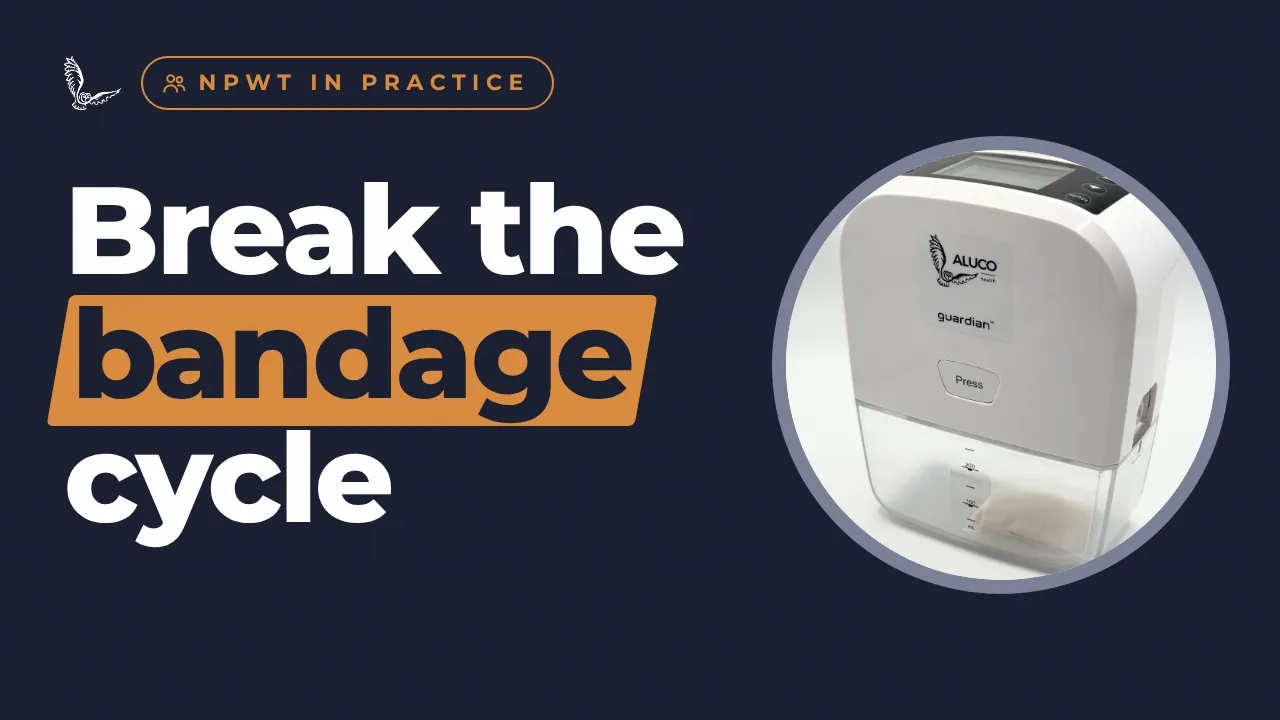
For vet teams and practice managers: what a long cycle of dressings and bandages can mean for the patient, the team and the owner, how often different dressings are changed, how to use the first negative pressure wound therapy (NPWT) interval to prepare the next step, and what NPWT can't promise.
Three things to remember
- Granulation is a step, not the goal.
- Plan the next step from day one.
- Review, then move on.
The full episode, written out
This is the narration from the video, so you can read it at your own pace, share it, or come back to a section.
Introduction
Welcome to Aluco Health. I'm Georgie Hollis. This is NPWT in Practice. Today: breaking the long bandage cycle. When does waiting for granulation become the problem?
Weeks of bandages
A common temptation is to keep going with conventional dressings and bandages for weeks, waiting for the wound to granulate and contract. Sometimes that's the right treatment. But when a repair is possible, it's worth asking what the long cycle is costing.
What a long cycle can mean
A long cycle can mean repeated interventions, ongoing discomfort for the patient and growing costs for the owner. And by the time a repair is considered, the wound bed may have matured, so the original options need rethinking. The MSD Veterinary Manual notes that open wound management costs more, takes longer, and can cause problems from contracture.
How often dressings are changed
Here's what one week can look like. Until a healthy bed forms, a conventional bandage needs changing at least once a day. Wet-to-dry dressings are re-dressed every twelve to twenty-four hours, needing some form of sedation or anaesthesia each time. NPWT dressings are usually changed every forty-eight to seventy-two hours.
In the published study
In the published study of forty-five dogs, the median time on NPWT was three days. The authors wrote that, at their hospital, NPWT has replaced wet-to-dry dressings as the standard of care for acute wounds. It's one hospital's experience, not a trial.
Granulation is a step
It helps to remember what granulation tissue is for. It's a means to an end, not necessarily the end goal.
Use the first interval well
If closure was considered on day one, the first NPWT interval can be used to prepare the wound and coordinate the next step, such as booking surgery or a referral. Then review at three to five days, and close, or move on to simpler dressings if the wound is healing open.
What may change
In well-chosen cases, that may mean fewer dressing interventions, less unnecessary delay, and a better opportunity for a functional repair. But NPWT doesn't always save time or money. The benefits depend on the wound and the patient.
Healing open, by plan
Healing open can be the right plan, as long as it is a plan. In one of our case reports, a wrist wound was too tight to stitch. After two NPWT applications over six days, it was less than half its original size, and the dog went home with a bandage to finish healing.
Keep bandaging?
So, should you keep bandaging until the wound has fully granulated? Not by default. Granulation is a step. Plan the closure, and review early.
Words explained
- Wet-to-dry dressing
- A moist dressing that dries and is pulled off, taking debris with it.
- Granulation tissue
- New, healthy healing tissue (red and bumpy).
- Contracture
- Scar tightening that can limit movement.
- Strike-through
- Fluid soaking through to the outside of a bandage.
Sources
- S1Aluco Health. Wound bed preparation: why timing matters in NPWT. Educational video script, draft, November 2026.
- S2Winkler KP. Initial wound management in small animals. MSD Veterinary Manual, professional version. Full review July 2023, updated September 2024. www.msdvetmanual.com/emergency-medicine-and-critical-care/wound-management-in-small-animals/initial-wound-management-in-small-animals
- S3Pitt KA, Stanley BJ. Negative pressure wound therapy: experience in 45 dogs. Vet Surg 2014;43(4):380–387. doi:10.1111/j.1532-950X.2014.12155.x pmc.ncbi.nlm.nih.gov/articles/PMC5026415
- S4Aluco Health. Aluco Guardian™ Negative Pressure Therapy System user manual / instructions for use, version 1, December 2024.
- S5Aluco Health. Case study 007: Carpal wound resolved by second intention. Case provided by Jill Cumath RVN, Cumath Pet Surgeons. Approved; published on alucohealth.com.
General information about animal wound care, not veterinary advice. Always follow your vet's advice. Aluco Guardian™ is for use by veterinary professionals. Evidence mentioned is not specific to Aluco Guardian™ unless we say so.
See the Aluco Guardian™ in your practice
Hire one for a single case, try it with a demonstration, or buy for a regular caseload. Training and round-the-clock clinical support for vet teams come with it.
Ask your vet whether NPWT could help
Your vet knows your pet best. Take your questions to them, or send them this page.
Watch next
 4:13
14 Jan
When do we stop NPWT, and what comes next?
 1:59
1 Dec
 3:23
1 Dec
 2:31
1 Dec