Skin grafts and flaps in dogs: how they work and how NPWT helps
Content note. The video shows real clinical wound photos from a clinician-reported case, shared with permission. They appear after a warning screen. The written guide below has no photos.
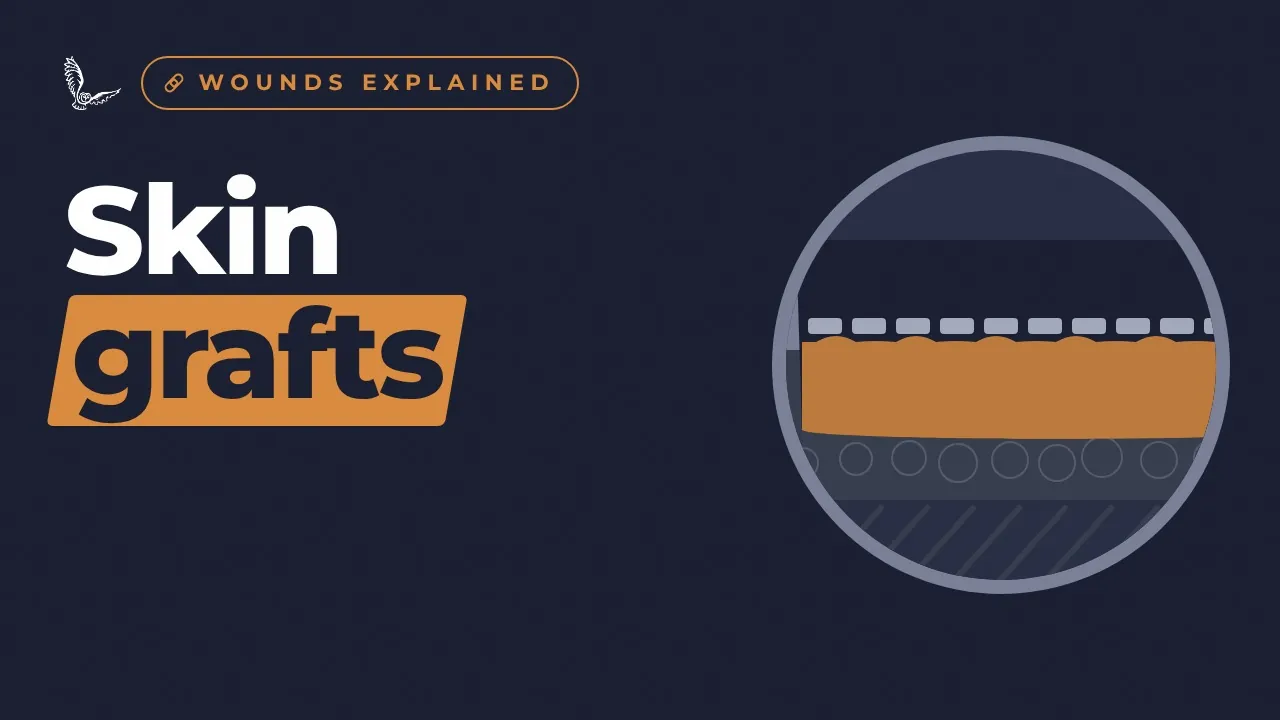
The difference between a skin flap and a skin graft, how a graft 'takes', what makes grafts fail, and the evidence for using negative pressure wound therapy (NPWT) over grafts, with a clinician-reported case. For pet owners and vet teams.
Three things to remember
- Flaps keep their own blood supply.
- Grafts need a healthy bed.
- A graft must be held close and still while it takes.
The full episode, written out
This is the narration from the video, so you can read it at your own pace, share it, or come back to a section.
Introduction
Welcome to Aluco Health. I'm Georgie Hollis. This is Wounds Explained. Today: skin grafts and flaps. How do surgeons move skin to close a big wound, and how can NPWT help a graft take?
Not enough skin
Some wounds are too big to stitch closed. On a leg, there may simply not be enough skin nearby. So surgeons move skin to cover the gap, as a flap or a graft. What's the difference?
Flap or graft
A flap is skin moved from nearby, still attached at one edge, so it keeps its own blood supply. A graft is a piece of skin cut free, often from the body, and laid over the wound. It has no blood supply of its own at first, so it has to connect to the wound bed. Grafts are common on the lower legs.
A healthy bed
A graft is laid on a healthy bed of new tissue, the red, bumpy granulation tissue. It's often meshed, with small cuts so it can stretch to fit. Grafts should only go onto a wound bed that is uniformly healthy.
How a graft takes
For the first two days, a graft survives by soaking up fluid from the bed underneath, while its blood vessels begin to join up. From about day three, tiny new blood vessels grow in. Then it attaches firmly. During this time, the graft must stay in close contact with the bed, and keep still.
Why grafts fail
So what makes grafts fail? Fluid collecting underneath, movement of the graft, and infection. That's why grafts are traditionally covered with a firm, padded dressing, called a bolster dressing, to hold them still.
What one study found
NPWT is used over grafts to hold them closely against the bed and draw fluid away. In a small randomised study of five dogs with ten grafts, healing tissue appeared in the mesh after a median of two days with NPWT, compared with seven days with a standard bolster dressing. There was also less graft death in the first ten days. It was a small, experimental study, using another manufacturer's system. Lower pressures are often used over grafts; the Aluco guide suggests about eighty to ninety millimetres of mercury.
A real example
Here's an example from Aura Veterinary. A large mixed-breed dog had a recurrent lump removed from the forearm. The wound was covered straight away with a meshed, full-thickness skin graft, and the Aluco Guardian was placed over it. The first dressing stayed in place for ninety-six hours, with the seal checked daily. When it came off, the team reported a hundred percent graft take, no fluid building up underneath, and a dog that stayed mobile. They reported hair regrowth and a functional repair at twenty-one days. This is one clinician-reported case.
Over flaps too
NPWT can also be used after a flap. In another of our case reports, a wound over a greyhound's wrist was partly closed with a pedicle flap. NPWT was put back on at a lower pressure, eighty to ninety millimetres of mercury, with a non-stick silicone mesh layer under the foam.
Myth or fact?
A graft isn't just a patch that sticks on. It's living skin that has to connect to a new blood supply. It needs a healthy bed, close contact, and stillness to take.
Words explained
- Flap
- Skin moved from nearby, still attached at one edge, so it keeps its blood supply.
- Graft
- A piece of skin cut free and laid over a wound.
- Meshing
- Small cuts made in a graft so it can stretch to fit.
- Graft take
- The graft attaching and growing a blood supply.
Sources
- S1Stanley BJ, Pitt KA, Weder CD, et al. Effects of negative pressure wound therapy on healing of free full-thickness skin grafts in dogs. Vet Surg 2013;42(5):511–522. pmc.ncbi.nlm.nih.gov/articles/PMC3671389
- S2Hattersley R. Management of canine and feline degloving injuries. Vet Times, 1 October 2018. www.vettimes.com/clinical/small-animal/management-of-canine-and-feline-degloving-injuries-cpdcriticalcare
- S3Campbell BG. Managing degloving and shearing injuries. Clinician's Brief, 2011. cliniciansbrief.com/article/managing-degloving-shearing-injuries
- S4Aluco Health. Aluco Guardian™ user guide: step-by-step application (presentation).
- S5Aluco Health. Case study 004: Post-oncology resection and skin grafting of the distal limb. Case provided by Nick Bacon, Aura Veterinary. Approved; published on alucohealth.com.
- S6Aluco Health. Case study 003: Greyhound with pancarpal arthrodesis wound breakdown. Case provided by Lisa Telford RVN, Edinburgh Veterinary School. Approved; published on alucohealth.com.
General information about animal wound care, not veterinary advice. Always follow your vet's advice. Aluco Guardian™ is for use by veterinary professionals. Evidence mentioned is not specific to Aluco Guardian™ unless we say so.
See the Aluco Guardian™ in your practice
Hire one for a single case, try it with a demonstration, or buy for a regular caseload. Training and round-the-clock clinical support for vet teams come with it.
Ask your vet whether NPWT could help
Your vet knows your pet best. Take your questions to them, or send them this page.
Watch next
 3:23
9 Feb
Why is the wound so big after my dog's lump was removed?
 1:59
1 Dec
 3:23
1 Dec
 2:31
1 Dec