Real case: a dog's wrist wound too tight to stitch, managed with NPWT
Content note. The video shows real clinical wound photos from a clinician-reported case, shared with permission. They appear after a warning screen. The written guide below has no photos.
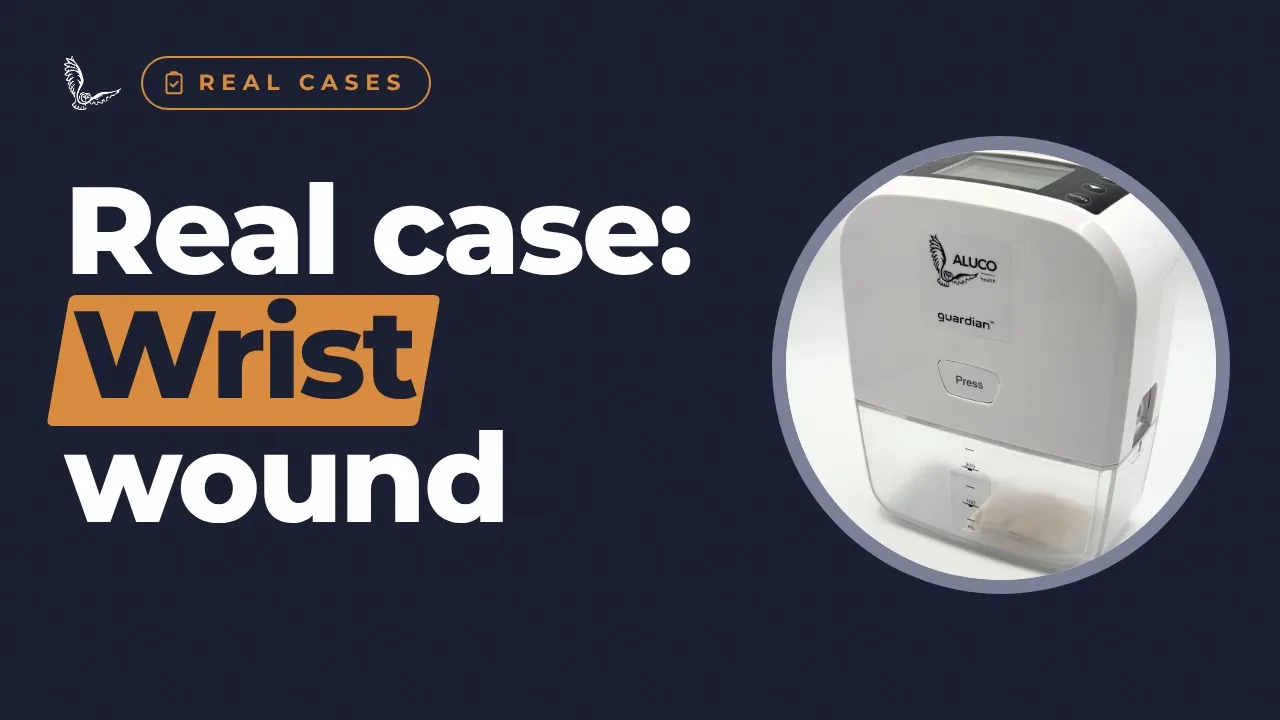
A clinician-reported case from Cumath Pet Surgeons: a large-breed dog with a wound over the front of the wrist, too tight to stitch closed. Two NPWT dressings over six days at 120 mmHg, with the foot enclosed in the film, then home with a bandage. After two applications the wound was less than half its original size. Contains wound photos. One case, not proof of effect.
Three things to remember
- A wrist wound too tight to stitch closed.
- Six days of NPWT, with two dressings.
- Then home with a bandage, less than half the size it started.
The full episode, written out
This is the narration from the video, so you can read it at your own pace, share it, or come back to a section.
Introduction
Welcome to Aluco Health. I'm Georgie Hollis. This is Real Cases, where we look at one clinician-reported case at a time. Today, a wound over the front of a dog's wrist, too tight to stitch closed, and managed with NPWT instead.
The patient
Our patient is a large-breed dog with a wound on the front of the wrist, called the carpus. The cause wasn't known. The team suspected a burst abscess, a pocket of infection that had broken open. A biopsy found no sign that it was caused by cancer spreading. The case was reported by Jill Cumath, a registered veterinary nurse at Cumath Pet Surgeons.
The challenge
The wrist moves all the time. If the team had stitched this wound closed straight away, the repair would have been under considerable tension. So they chose NPWT, to help build healthy healing tissue, while reducing the shearing forces, the dragging and sliding, that movement puts on the wound.
How it was applied
Under anaesthesia, the team clipped a wide area around the wound, prepared the skin aseptically, and debrided and cleaned the wound. NPWT was applied at one hundred and twenty millimetres of mercury. To get a complete seal on a lower leg, they enclosed the whole foot in the film. Aluco clinical support joined live by video, to help the team position the dressing and film in the way that suited this wound.
Six days of NPWT
The first dressing stayed on for three days, and the foam was replaced at day three. The dog stayed in hospital throughout, so the team could make sure the pressure held. There were no complications, and the dog stayed comfortable. By day six, the wound was significantly smaller, with a healthy edge of new skin.
Home with a bandage
After two applications, the wound was less than half its original size. The dog went home with a foam dressing and a standard limb bandage, to finish healing at home. At a check-up one week later, the wound was smaller again, with no adverse events, no interference from the patient, and no other problems.
Take-aways
What can vet teams take from this case? On a lower leg, enclosing the foot in the film gave a complete seal. If you're new to the system, live support can help you plan the dressing for an awkward wound. And not every wound has to be stitched closed; here, NPWT supported healing from the bottom up, called second intention, with the last stage of healing at home. Remember, this is one clinician-reported case. It shows what happened for this dog, not how other wounds will respond.
Words explained
- Carpus
- A dog's wrist.
- Abscess
- A pocket of infection.
- Second intention
- Letting a wound heal on its own from the bottom up, rather than stitching it closed.
- Shearing forces
- The dragging and sliding that movement puts on a wound.
- Debridement
- Removing dead or contaminated tissue from a wound.
Sources
- S1Aluco Health. Case study 007: Carpal wound resolved by second intention. Case provided by Jill Cumath RVN, Cumath Pet Surgeons. Approved; published on alucohealth.com.
General information about animal wound care, not veterinary advice. Always follow your vet's advice. Aluco Guardian™ is for use by veterinary professionals. Evidence mentioned is not specific to Aluco Guardian™ unless we say so.
See the Aluco Guardian™ in your practice
Hire one for a single case, try it with a demonstration, or buy for a regular caseload. Training and round-the-clock clinical support for vet teams come with it.
Ask your vet whether NPWT could help
Your vet knows your pet best. Take your questions to them, or send them this page.
Watch next
 3:22
7 Jan
 1:59
1 Dec
 2:31
1 Dec
Aluco Guardian NPWT: how to change the canister
 4:40
1 Dec