What does overnight NPWT care involve? A guide for practice teams
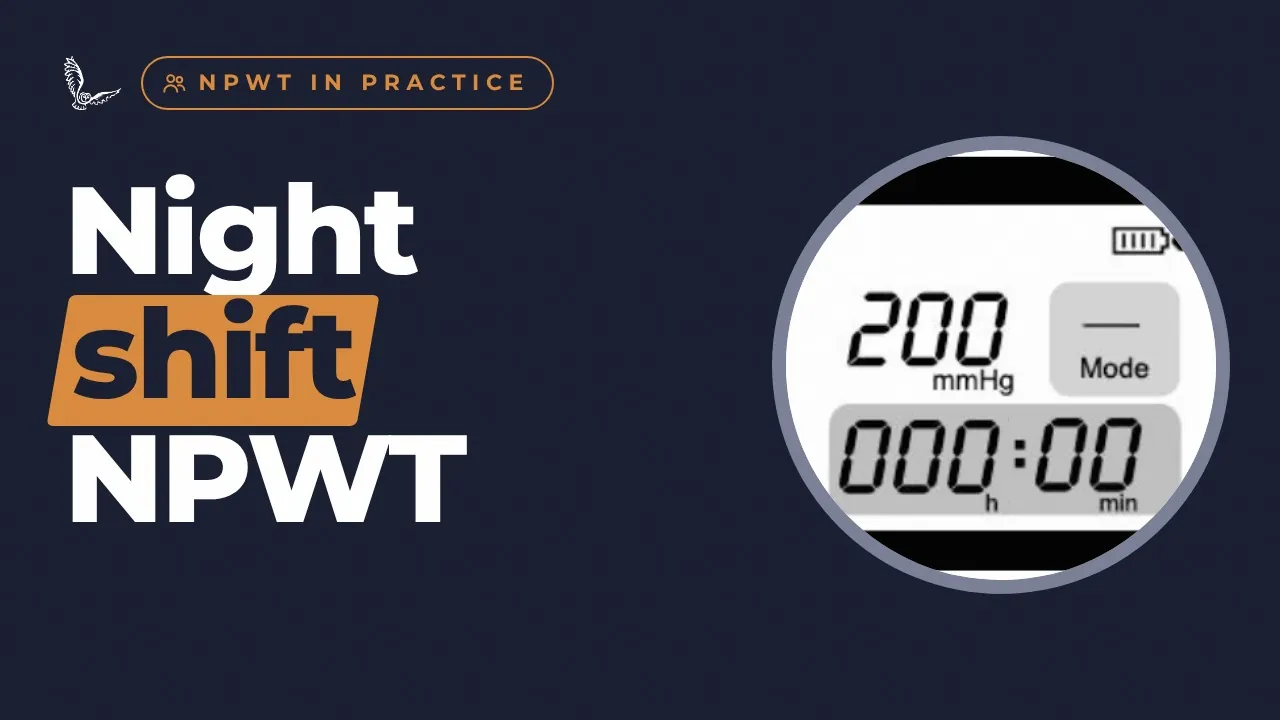
Overnight care for patients on negative pressure wound therapy (NPWT): the two-hour rule, the handover, patient and pump checks, how often to check, who responds to problems, power, records and the out-of-hours plan. For practice teams.
Three things to remember
- Hand over properly.
- Check the seal, the pump and the patient.
- Stay inside two hours.
The full episode, written out
This is the narration from the video, so you can read it at your own pace, share it, or come back to a section.
Introduction
Welcome to Aluco Health. I'm Georgie Hollis. This is NPWT in Practice. NPWT keeps working through the night, so your team needs a plan for the night too. In this episode: the handover, the checks, who responds to problems, and the out-of-hours plan.
The two-hour rule
Every overnight plan comes back to one number: two hours. The manual says never leave a dressing in place without negative pressure for more than two hours. If therapy has been off for longer, the old dressing comes off, and the wound is irrigated. That's why someone needs to be able to spot and fix a problem quickly, at any hour.
The handover
Start with a proper handover. The day team passes on the patient: the wound, pain relief, the E-collar, and whether they're eating. The settings: pressure, mode, and when therapy started. The canister: its level and colour, and when it was last changed. The seal: any leaks so far, and how they were fixed. The plan: check times, and when the next dressing change is due. And who to call.
Patient checks
Patient checks come first. Is the patient comfortable, or restless and interested in the dressing? Is the E-collar on, with the tubing out of reach? In a published study of forty-five dogs, chewed or kinked tubing made the pump fail in three dogs, and good E-collars and cage confinement solved it. Check any bandage is dry and in place. And watch for infection: the manual says to contact the treating clinician immediately if there's any sign it's spreading or affecting the whole patient.
Pump checks
Then the pump. Is the pressure on the display what was set, with the timer running? Is the foam still collapsed and wrinkled? If it isn't, or you hear a faint whistle, there's probably a leak. Is the tubing free of kinks? Record the canister level, and the colour and thickness of the fluid. And is the unit upright and plugged in? Hanging it upright outside the kennel makes checking easy, and one team found hanging it upright avoided false full-canister alarms.
How often?
How often should you check? One veterinary guide suggests checking the dressing every four hours. One of our case reports, from Edinburgh, kept the patient in for twenty-four-hour monitoring, with checks every two hours. Whatever you choose, the pump sounds an alarm if the pressure drops or the line blocks, so make sure someone will hear it, and can act well within the two-hour limit.
Power
Keep the pump on mains power overnight. If it's unplugged, the battery should last at least twelve hours, and a low-battery alarm sounds when less than twenty minutes of therapy is left. Plug it straight in, and the alarm stops.
Who responds?
Agree in advance who responds to what. A named nurse or vet does the checks, records them, and fixes simple problems, like a small leak; teams in our case reports patched those with stoma paste. The on-call vet makes the clinical decisions, including whether a dressing needs to come off. And your team can call Aluco's clinical support at any hour, for advice on the device or the dressing.
The out-of-hours plan
Then the out-of-hours plan. If someone will be on site all night, name them, and set the check times. If not, sort it out before the first dressing goes on. Talk to your out-of-hours provider about transferring the patient, or agree another plan that keeps you inside the two-hour rule. In the published study, most dogs stayed in hospital while on NPWT; only three were managed at home.
Write it down
Write everything down: check times, and who did them; the pressure, and any alarms, with what you did about them; the canister volume, and the colour and thickness of the fluid; and how the patient is. Falling volume and clearer fluid can be a sign of progress. Other changes may mean the wound is getting worse, so flag them at handover.
Myth or fact?
Here's a common belief: if the pump is quiet, everything's fine. Not always. The low-pressure alarm only sounds when the pressure falls below twenty millimetres of mercury, so check the display matches the setting at every check.
Words explained
- Exudate
- Fluid that comes out of a wound.
- Canister
- The pot on the pump that collects wound fluid.
- Seal
- The airtight cover made by the film over the foam.
Sources
- S1Aluco Health. Aluco Guardian™ Negative Pressure Therapy System user manual / instructions for use, version 1, December 2024.
- S2Pitt KA, Stanley BJ. Negative pressure wound therapy: experience in 45 dogs. Vet Surg 2014;43(4):380–387. doi:10.1111/j.1532-950X.2014.12155.x pmc.ncbi.nlm.nih.gov/articles/PMC5026415
- S3Hollis G. Reviewing negative pressure wound therapy in animals. Vet Times, 12 November 2024. www.vettimes.com/news/vets/small-animal-vets/reviewing-negative-pressure-wound-therapy-in-animals
- S4Negative pressure wound therapy: a guide for small animal practitioners. Veterinary Practice (undated web article). www.veterinary-practice.com/article/negative-pressure-wound-therapy-npwt
- S5Aluco Health. Case study 009: Wound breakdown after wide mast cell tumour excision. Case provided by Lisa Telford RVN, Edinburgh Veterinary School. Approved; published on alucohealth.com.
- S6Aluco Health. Case study 006: Hindlimb wound after wide mast cell tumour resection. Case provided by Jackie Demetriou, Granta Veterinary Specialists. Approved; published on alucohealth.com.
- S7Aluco Health. Case study 005: Necrotising fasciitis. Case provided by Nick Bacon, Aura Veterinary. Approved; published on alucohealth.com.
- S8Aluco Health. Case study 001: Nico, rapid granulation and definitive closure. Case provided by Anna Cronin DipECVS, Wear Referrals. Approved; published on alucohealth.com.
- S9Aluco Health. Case study 002: Cocker spaniel with severe bilateral inguinal SSIs. Case provided by Anna Cronin DipECVS, Wear Referrals. Approved; published on alucohealth.com.
- S10Aluco Health. Round-the-clock clinical support for veterinary teams (company confirmation, 20 November 2026; user guide: 24/7 clinical support by WhatsApp).
- S11Aluco Health. Aluco Guardian™ user guide for trained clinical staff, December 2025.
General information about animal wound care, not veterinary advice. Always follow your vet's advice. Aluco Guardian™ is for use by veterinary professionals. Evidence mentioned is not specific to Aluco Guardian™ unless we say so.
See the Aluco Guardian™ in your practice
Hire one for a single case, try it with a demonstration, or buy for a regular caseload. Training and round-the-clock clinical support for vet teams come with it.
Ask your vet whether NPWT could help
Your vet knows your pet best. Take your questions to them, or send them this page.
Watch next
 4:00
1 Dec
NPWT set-up: what do I need ready before I start?
 1:59
1 Dec
 3:23
1 Dec
 2:31
1 Dec