NPWT set-up: what do I need ready before I start?
Content note. The video shows real clinical wound photos from a clinician-reported case, shared with permission. They appear after a warning screen. The written guide below has no photos.
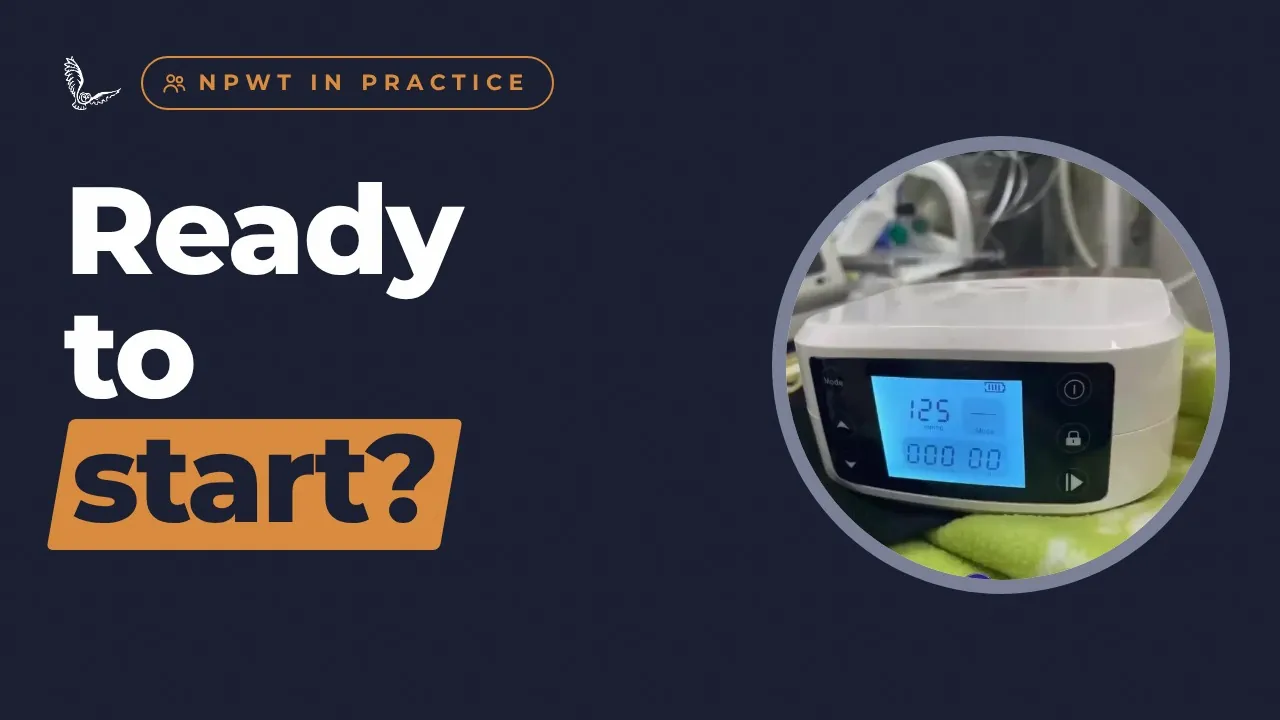
Getting ready for a first NPWT dressing: the pump checks, the trolley and prep kit, the application sequence in real photos, how to help the seal hold, and the team briefing. For vet teams. Contains wound photos.
Three things to remember
- Charge and check the pump.
- Clip wide, and clean well.
- Brief the team first.
The full episode, written out
This is the narration from the video, so you can read it at your own pace, share it, or come back to a section.
Introduction
Welcome to Aluco Health. I'm Georgie Hollis. This is NPWT in Practice. The first dressing goes on much more smoothly when everything is ready before the patient is. In this episode: the pump, the trolley, the kit, and the team briefing.
The most common problem
In a published study of forty-five dogs, the main problem with NPWT was losing the seal, because the film didn't stick well enough to the skin around the wound. Careful clipping and cleaning of that skin reduced it. So preparation really matters.
The pump
Start with the pump. Charge it, and check the unit, battery, canister and tubing for damage. Click the canister in with the unit switched off, until you hear it click. And plan where it will hang, upright, once the patient is back in the kennel.
The trolley
On the trolley: the sterile dressing kit, with foam, film, and a pad with tubing. Check the packaging isn't damaged. Add extra film for awkward edges, stoma paste to build a second seal in creases, and spare canisters if the wound is very wet.
Prep kit
Then the prep kit you already have. Clippers, for a wide clip. A lavage set: Anna Cronin's team at Wear Referrals uses a fluid bag, giving set, three-way tap and syringe. Sterile instruments for debridement. Skin prep. Sterile scissors to cut the foam. And an E-collar, with padding for a bandage over limb dressings.
Prepare the wound
Here's the sequence, in photos from a real case. The first application is usually done under sedation or anaesthesia. Clip at least ten centimetres around the wound, more near the elbow or stifle, and right the way round a limb. Lavage and debride. Cut the foam to the wound's shape, so it sits inside the wound without overlapping the skin. Then cover it with film, leaving a border of three to five centimetres on healthy skin.
Seal and connect
Cut a small hole in the film over the foam, and stick the pad over it. Connect the tube to the canister, and make sure the stopper is open. Then switch on, set the pressure, and start. Aluco's guides give around a hundred and twenty to a hundred and twenty-five millimetres of mercury for open wounds, and eighty to ninety over grafts and suture lines, but it's a clinical decision. When the seal is good, the foam collapses and looks wrinkled.
Help the seal hold
Then smooth the film down by hand, with gentle pressure over the wound to help it stick. Use stoma paste to fill creases and dips; that's how the published study team dealt with leaks around the toes. If you hear a faint whistle, that's a leak. Find it, and reinforce the seal.
The team briefing
Finally, brief the team before you start. Who applies the dressing, who assists, and who records. The pressure and mode, written down. What gets checked, and how often. The two-hour rule: a dressing must never sit without suction for longer than that. Who to call if there's a problem: your vet on call, and Aluco's round-the-clock clinical support. And when the first dressing change is due, usually forty-eight to seventy-two hours later.
Myth or fact?
One common belief is that the pump is the tricky part. In practice, it's the seal. Clip wide, clean well, and smooth the film, and you'll avoid the most common problem.
Words explained
- Lavage
- Flushing a wound with fluid to clean it.
- Debridement
- Removing dead, damaged or dirty tissue.
- Stoma paste
- A mouldable paste used to fill creases so the film seals.
Sources
- S1Aluco Health. Aluco Guardian™ Negative Pressure Therapy System user manual / instructions for use, version 1, December 2024.
- S2Aluco Health. Aluco Guardian™ user guide for trained clinical staff, December 2025.
- S3Aluco Health. Aluco Guardian™ user guide: step-by-step application (presentation).
- S4Pitt KA, Stanley BJ. Negative pressure wound therapy: experience in 45 dogs. Vet Surg 2014;43(4):380–387. doi:10.1111/j.1532-950X.2014.12155.x pmc.ncbi.nlm.nih.gov/articles/PMC5026415
- S5Cronin A. The witch's remedy: negative pressure wound therapy for haunting wounds. Wear Referrals webinar recording, supplied to Aluco Health.
- S6Aluco Health. Case study 001: Nico, rapid granulation and definitive closure. Case provided by Anna Cronin DipECVS, Wear Referrals. Approved; published on alucohealth.com.
- S7Aluco Health. Case study 002: Cocker spaniel with severe bilateral inguinal SSIs. Case provided by Anna Cronin DipECVS, Wear Referrals. Approved; published on alucohealth.com.
- S8Aluco Health. Round-the-clock clinical support for veterinary teams (company confirmation, 20 November 2026; user guide: 24/7 clinical support by WhatsApp).
General information about animal wound care, not veterinary advice. Always follow your vet's advice. Aluco Guardian™ is for use by veterinary professionals. Evidence mentioned is not specific to Aluco Guardian™ unless we say so.
See the Aluco Guardian™ in your practice
Hire one for a single case, try it with a demonstration, or buy for a regular caseload. Training and round-the-clock clinical support for vet teams come with it.
Ask your vet whether NPWT could help
Your vet knows your pet best. Take your questions to them, or send them this page.
Watch next
 4:09
1 Dec
 1:59
1 Dec
 3:23
1 Dec
 2:31
1 Dec