Wound bed preparation in NPWT: why timing matters
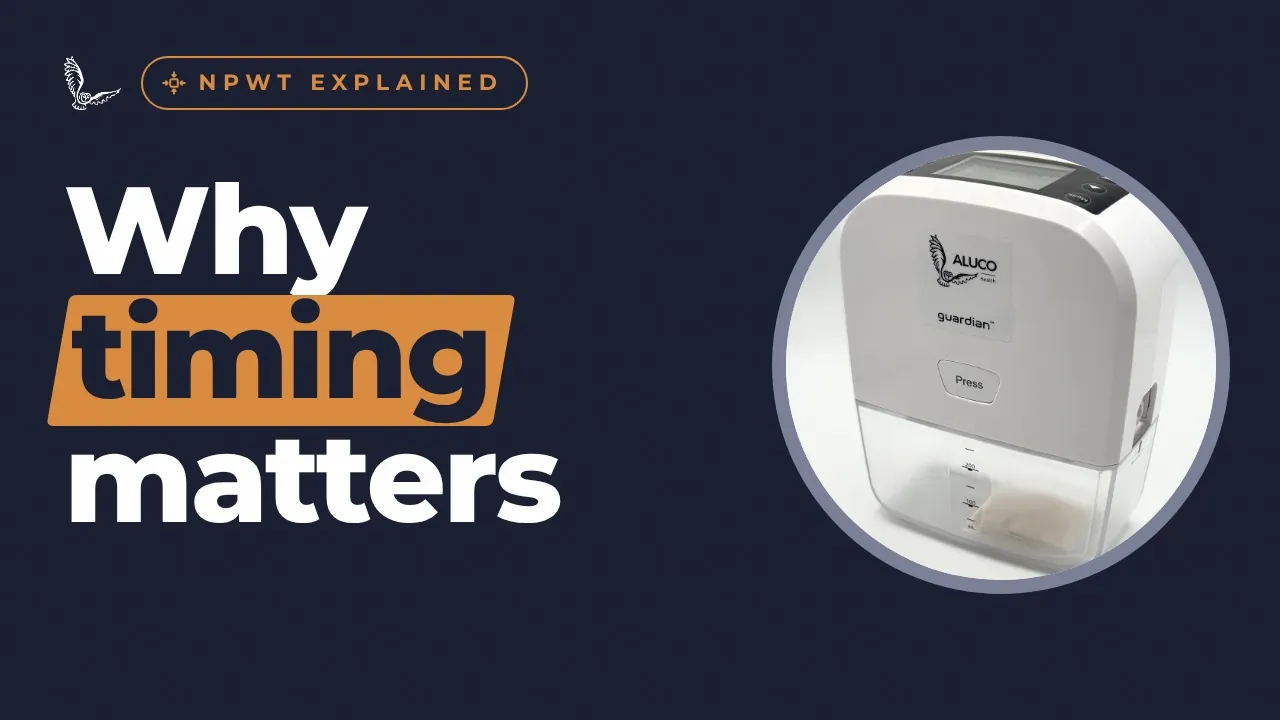
Why wound bed preparation and early closure planning matter when using negative pressure wound therapy (NPWT) in dogs and cats: the stages of healing, assessing and debriding the wound, choosing the likely closure route on day one, how NPWT supports the process, a review at three to five days, and avoiding a long bandage cycle.
Three things to remember
- Prepare the wound bed properly.
- Plan the closure on day one.
- Review after three to five days of NPWT.
The full episode, written out
This is the narration from the video, so you can read it at your own pace, share it, or come back to a section.
Introduction
Welcome to Aluco Health. I'm Georgie Hollis. This is NPWT Explained. Today: wound bed preparation, and why timing matters. When should we start thinking about how a wound will close?
Healing isn't the whole goal
The aims of wound management are simple: a functional repair that looks acceptable, relief of pain and distress, and a return to normal use. But getting a wound to heal isn't the same as getting a good functional result. It's easy to focus on growing healing tissue, or keeping a wound covered until it closes, and lose sight of the final repair.
Four stages, overlapping
However large or small a wound is, it heals through the same basic stages. Bleeding is controlled first; vets call this haemostasis. Then inflammation, when damaged cells, germs and debris are cleared away. Then repair: from about three days, new cells and blood vessels build granulation tissue to fill the gap. Last comes remodelling, which can carry on for up to two years. The stages overlap rather than following one after another.
What will it leave behind?
Left to heal on its own, which vets call second intention, a wound closes through granulation, contraction and new skin growing across. Sometimes that's exactly right. But scar isn't the same as the original skin, and most healed wounds stay fifteen to twenty percent weaker than the original tissue. So the question isn't just 'can this wound heal?', but what tissue and function do we want to be left with?
Assess first
Before NPWT is even considered, the wound needs a proper assessment, after first checking the overall stability of the animal. Is the tissue alive? Skin that's blue-black, leathery, thin or white usually isn't. Is there contamination or infection? Is the blood supply adequate? And are deeper structures involved?
Debridement comes first
A common mistake is not removing enough dead tissue. Dead tissue can't contribute to healthy repair, and leaving it in place can keep inflammation going, support bacterial growth and delay healing. Good debridement, cleaning, infection management where needed and an honest look at what's viable all come first. NPWT is not a substitute for surgical judgement or proper wound preparation.
Plan the closure on day one
This may be the most important message. The plan for closing the wound starts on day one, not when a healthy bed finally appears. Before NPWT starts, the team asks: could this wound be closed directly? Might it need a flap or graft? Would healing on its own be the better option? And do we have the facilities and skills, or should a specialist be involved? Nobody wants to spend days preparing a wound only to find that nobody has planned how it will be closed.
Not every practice reconstructs
Not every first-opinion practice needs to do complex reconstruction itself. It can still provide NPWT as part of a coordinated plan, as long as closure or referral is thought about from the beginning. The aim is a clear direction early, not an arbitrary deadline for surgery. The surgical decisions stay with the attending vet and any specialists involved.
How NPWT supports the process
Once the wound is properly prepared, NPWT can complement natural healing. It draws fluid away, keeps the wound sealed, warm and moist, and limits movement and shear at the wound surface. It's also thought to help reduce swelling and support granulation tissue as the gap fills. We're not asking the pump to heal the wound instead of the patient. We're using it to support the biology that's already happening.
Review at three to five days
NPWT dressings are usually changed every forty-eight to seventy-two hours. In suitable cases, the team reassesses after about three to five days of NPWT. Some wounds will have a healthy, granulating bed ready for the next step. Others will need further debridement, infection control or other treatment. It's a review point, not a promise.
The long bandage cycle
A common temptation is to keep going with dressings and bandages for weeks while waiting for the wound to fill and shrink. Sometimes that's right. But when a repair is possible, a long cycle can mean repeated interventions, ongoing discomfort and growing costs. In the published forty-five-dog study, wet-to-dry dressings needed changing every twelve to twenty-four hours, often with sedation each time. Granulation tissue is a means to an end, not always the goal itself.
NPWT will sort it out
So, is NPWT a way to sort out a wound that hasn't been prepared? No. It supports a prepared wound and the plan around it. And it doesn't always save time or money; the benefits depend on the wound and the patient.
Words explained
- Haemostasis
- The body stopping the bleeding.
- Granulation tissue
- New, healthy healing tissue (red and bumpy).
- Second intention
- Letting a wound heal on its own, from the bottom up, instead of closing it.
- Debridement
- Removing dead or damaged tissue and dirt from a wound.
- Exudate
- The fluid a wound produces.
Sources
- S1Aluco Health. Wound bed preparation: why timing matters in NPWT. Educational video script, draft, November 2026.
- S2Winkler KP. General principles of wound healing in small animals. MSD Veterinary Manual, professional version. Full review July 2023, updated September 2024. www.msdvetmanual.com/emergency-medicine-and-critical-care/wound-management/general-principles-of-wound-healing-in-animals
- S3Winkler KP. Initial wound management in small animals. MSD Veterinary Manual, professional version. Full review July 2023, updated September 2024. www.msdvetmanual.com/emergency-medicine-and-critical-care/wound-management-in-small-animals/initial-wound-management-in-small-animals
- S4Orgill DP, Bayer LR. Negative pressure wound therapy: past, present and future. Int Wound J 2013;10(Suppl 1):15–19. pmc.ncbi.nlm.nih.gov/articles/PMC7950903
- S5Pitt KA, Stanley BJ. Negative pressure wound therapy: experience in 45 dogs. Vet Surg 2014;43(4):380–387. doi:10.1111/j.1532-950X.2014.12155.x pmc.ncbi.nlm.nih.gov/articles/PMC5026415
- S6Aluco Health. Aluco Guardian™ Negative Pressure Therapy System user manual / instructions for use, version 1, December 2024.
- S7Aluco Health. Round-the-clock clinical support for veterinary teams (company confirmation, 20 November 2026; user guide: 24/7 clinical support by WhatsApp).
General information about animal wound care, not veterinary advice. Always follow your vet's advice. Aluco Guardian™ is for use by veterinary professionals. Evidence mentioned is not specific to Aluco Guardian™ unless we say so.
See the Aluco Guardian™ in your practice
Hire one for a single case, try it with a demonstration, or buy for a regular caseload. Training and round-the-clock clinical support for vet teams come with it.
Ask your vet whether NPWT could help
Your vet knows your pet best. Take your questions to them, or send them this page.
Watch next
 3:25
12 Jan
 1:59
1 Dec
 3:23
1 Dec
 2:31
1 Dec