How does negative pressure wound therapy work? What NPWT does to tissue
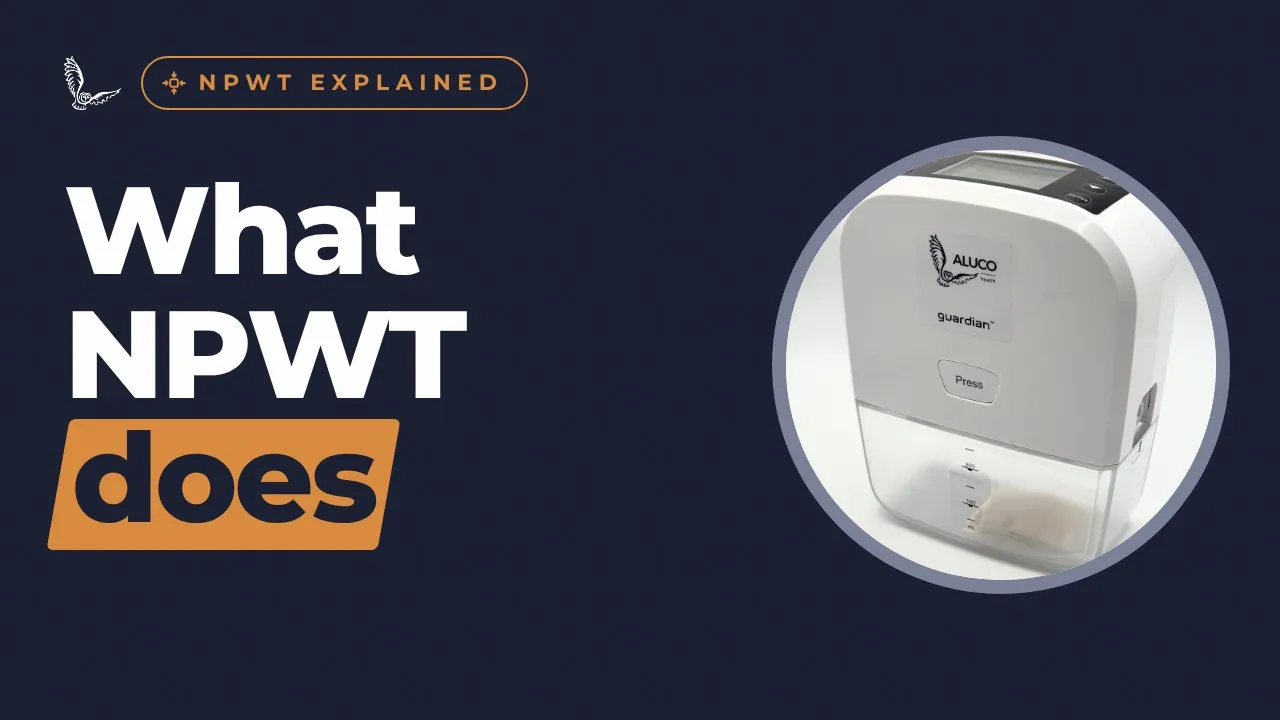
How negative pressure wound therapy (NPWT) is thought to work: the four main mechanisms (fluid removal, drawing the wound edges together, stretching cells at the surface, and a sealed, warm, moist environment), what a veterinary study found, what is still uncertain, and what NPWT can't do.
Three things to remember
- NPWT draws fluid away.
- It pulls the wound edges in and stretches cells at the surface.
- It supports the healing the body is already doing.
The full episode, written out
This is the narration from the video, so you can read it at your own pace, share it, or come back to a section.
Introduction
Welcome to Aluco Health. I'm Georgie Hollis. This is NPWT Explained. Today: what NPWT actually does to the tissue in a wound.
Not just suction
NPWT is more than a vacuum. We're not asking the pump to heal the wound instead of the patient. We're using it to support the biology that's already happening. So what does it actually do?
Four effects
Researchers describe four main mechanisms. NPWT draws fluid away. It draws the wound edges together. It stretches cells at the wound surface. And it keeps the wound sealed, warm and moist. Let's take them one at a time.
Macrodeformation
First, macrodeformation. Under suction, the foam collapses and wrinkles, and draws the wound edges together. How much depends on how mobile the surrounding tissue is.
Microdeformation
Second, microdeformation. At a microscopic level, the wound surface is deformed, and that stretches cells, which encourages them to divide and multiply. This is thought to be one of the drivers of new granulation tissue.
Fluid removal
Third, fluid removal. NPWT can remove large amounts of fluid from the spaces between cells. That's thought to help reduce swelling, and the fluid goes into a sealed canister, where the team can see how much there is.
The wound environment
Fourth, the environment. The semi-sealed film keeps the wound warm and moist, and the dressing limits movement and shear at the wound surface. Together, these effects lead to others, including new granulation tissue.
In dogs
What about dogs? In one experimental study of ten dogs with created wounds, granulation tissue appeared earlier with NPWT than with standard care. It's a small study, so it shows what may happen, not what always will.
Do we know exactly how?
So, has science worked out exactly how NPWT works? Not completely. Several mechanisms have been proposed, including changes in blood flow, called perfusion, but no single theory explains it all.
What NPWT can't do
And it helps to know its limits. NPWT doesn't remove dead tissue; that's debridement, done first. It's not a substitute for surgical judgement. A review after a few days is not a promise that the wound will be ready. And NPWT doesn't always save time or money; it depends on the wound and the patient.
Words explained
- Macrodeformation
- The whole wound being drawn together as the foam shrinks.
- Microdeformation
- Tiny stretching of cells at the wound surface.
- Exudate
- The fluid a wound produces.
- Granulation tissue
- New, healthy healing tissue (red and bumpy).
Sources
- S1Orgill DP, Bayer LR. Negative pressure wound therapy: past, present and future. Int Wound J 2013;10(Suppl 1):15–19. pmc.ncbi.nlm.nih.gov/articles/PMC7950903
- S2Lalezari S, Lee CJ, Borovikova AA, et al. Deconstructing negative pressure wound therapy. Int Wound J 2017;14(4):649–657. pubmed.ncbi.nlm.nih.gov/27681204/
- S3Aluco Health. Wound bed preparation: why timing matters in NPWT. Educational video script, draft, November 2026.
- S4Demaria M, Stanley BJ, Hauptman JG, et al. Effects of negative pressure wound therapy on healing of open wounds in dogs. Vet Surg 2011;40(6):658–669. pubmed.ncbi.nlm.nih.gov/?term=Demaria+Stanley+2011+negative+pressure+wound+therapy+open+wounds+dogs
- S5Aluco Health. Aluco Guardian™ Negative Pressure Therapy System user manual / instructions for use, version 1, December 2024.
General information about animal wound care, not veterinary advice. Always follow your vet's advice. Aluco Guardian™ is for use by veterinary professionals. Evidence mentioned is not specific to Aluco Guardian™ unless we say so.
See the Aluco Guardian™ in your practice
Hire one for a single case, try it with a demonstration, or buy for a regular caseload. Training and round-the-clock clinical support for vet teams come with it.
Ask your vet whether NPWT could help
Your vet knows your pet best. Take your questions to them, or send them this page.
Watch next
 5:28
26 Jan
Wound bed preparation in NPWT: why timing matters
 1:59
1 Dec
 3:23
1 Dec
 2:31
1 Dec