Real case: Nico, an infected wound after pelvic fracture repair (NPWT)
Content note. The video shows real clinical wound photos from a clinician-reported case, shared with permission. They appear after a warning screen. The written guide below has no photos.
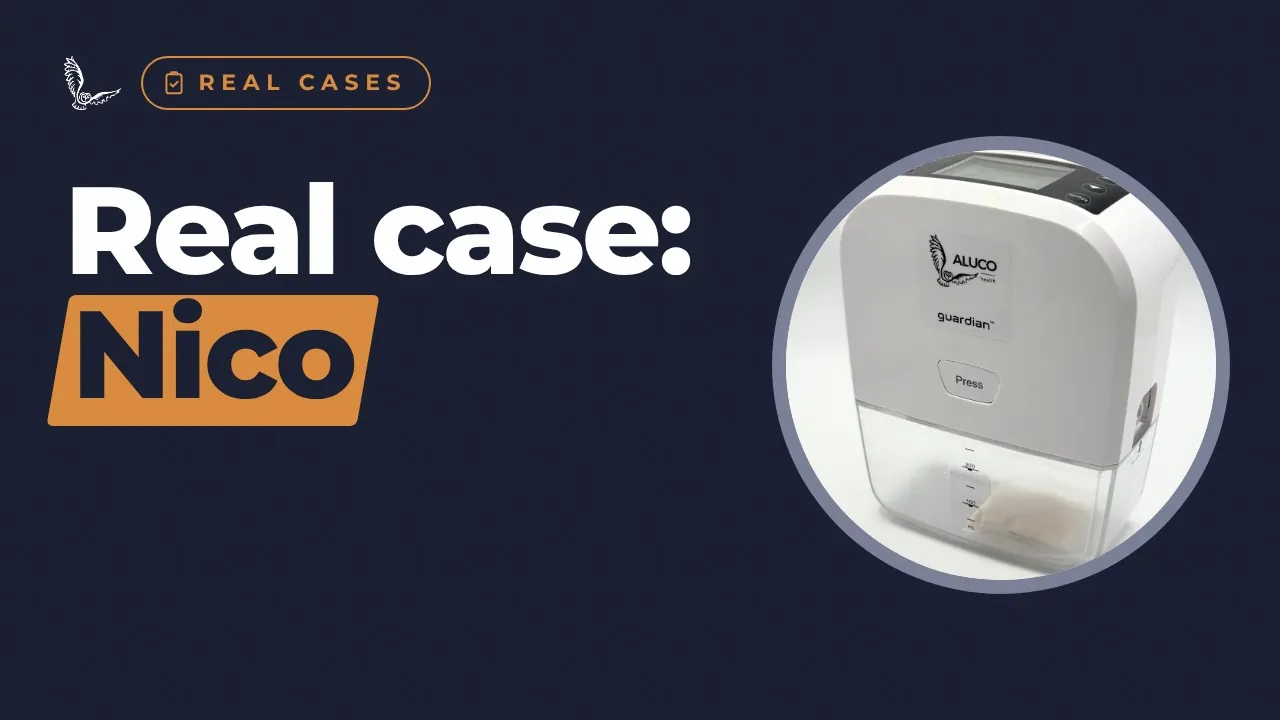
A clinician-reported case from Wear Referrals: Nico, an eight-year-old large-breed dog whose surgical wound became infected and broke down after pelvic fracture repair, managed with three days of continuous negative pressure wound therapy before the wound was closed. Contains wound photos. One case, not proof of effect.
Three things to remember
- A deep, infected wound after fracture repair.
- Three days on continuous NPWT.
- Then the wound was stitched closed, and Nico went back to normal.
The full episode, written out
This is the narration from the video, so you can read it at your own pace, share it, or come back to a section.
Introduction
Welcome to Aluco Health. I'm Georgie Hollis. This is Real Cases, where we look at one clinician-reported case at a time. Today it's Nico, a large dog whose surgical wound became infected and broke down after his fractures were repaired.
Meet Nico
Nico is an eight-year-old, large, mixed-breed dog. He was run over by a pick-up truck, with serious injuries to his abdomen, his urinary system and kidneys, and several fractures of his pelvis. After his fractures were repaired, the surgical wound became infected and broke down. His case was reported by Anna Cronin, a specialist surgeon at Wear Referrals.
The challenge
Nico wasn't eating and was difficult to handle. The wound was deep and infected, so ordinary bandages would have needed changing every day, and each change would have meant sedation or an anaesthetic. For a dog who was stressed and not eating, that carried real risk. So the team's goals were to control the wound fluid, reduce swelling, encourage healthy healing tissue, and cut down on repeated anaesthetics.
The treatment
Under general anaesthetic, the team cleaned away the dead tissue and flushed the wound. They used a sterile template to size the gap, and cut the foam to fill the pocket without overstuffing it. Clear film went over the top, smoothed to get rid of creases. A small hole, five to ten millimetres across, was cut over the foam for the suction tubing, which ran to a single-use canister on the pump.
The settings
Suction was set to one hundred and twenty-five millimetres of mercury, continuous. The dressing stayed in place for seventy-two hours. The wound produced a lot of fluid, so canisters were changed as needed, and four were used. Nursing staff checked the seal every day, and added stoma paste at one small edge that kept leaking.
During treatment
During treatment, Nico tolerated the therapy well. He ate, rested and was able to move about with minimal stress. Here he is out of his kennel during his stay, with the team beside him.
After three days
After three days of continuous negative pressure, the team reported healthy healing tissue, called granulation tissue, across the deep pocket. The swelling had gone down, and there was much less wound fluid. On the left, before. On the right, after three days.
Closing the wound
With a healthy wound bed, the surgeons could stitch the wound closed, without needing a long period of further open wound care. They placed a drain, a thin tube that lets fluid escape, to stop a pocket of fluid building up under the skin. Nico recovered, and his appetite and activity returned to normal.
Take-aways
What can vet teams take from Nico's case? Plan your stock, because a very wet wound can fill several canisters. Check the seal every day, and patch any edge that keeps leaking. And keep the unit upright, which the team notes helps avoid false alarms. Remember, this is one clinician-reported case. It shows what happened for Nico, not how other wounds will respond.
Words explained
- Wound breakdown
- A surgical wound that has opened up again (dehiscence).
- Granulation tissue
- New, healthy healing tissue (red and bumpy).
- Secondary closure
- Stitching a wound closed once it is ready, rather than straight away.
- Drain
- A thin tube that lets fluid escape from under the skin.
Sources
- S1Aluco Health. Case study 001: Nico, rapid granulation and definitive closure. Case provided by Anna Cronin DipECVS, Wear Referrals. Approved; published on alucohealth.com.
- S2Cronin A. The witch's remedy: negative pressure wound therapy for haunting wounds. Wear Referrals webinar recording, supplied to Aluco Health.
General information about animal wound care, not veterinary advice. Always follow your vet's advice. Aluco Guardian™ is for use by veterinary professionals. Evidence mentioned is not specific to Aluco Guardian™ unless we say so.
See the Aluco Guardian™ in your practice
Hire one for a single case, try it with a demonstration, or buy for a regular caseload. Training and round-the-clock clinical support for vet teams come with it.
Ask your vet whether NPWT could help
Your vet knows your pet best. Take your questions to them, or send them this page.
Watch next
 1:59
1 Dec
 2:31
1 Dec
Aluco Guardian NPWT: how to change the canister
 4:40
1 Dec