NPWT pressure settings and modes explained (mmHg, continuous, intermittent)
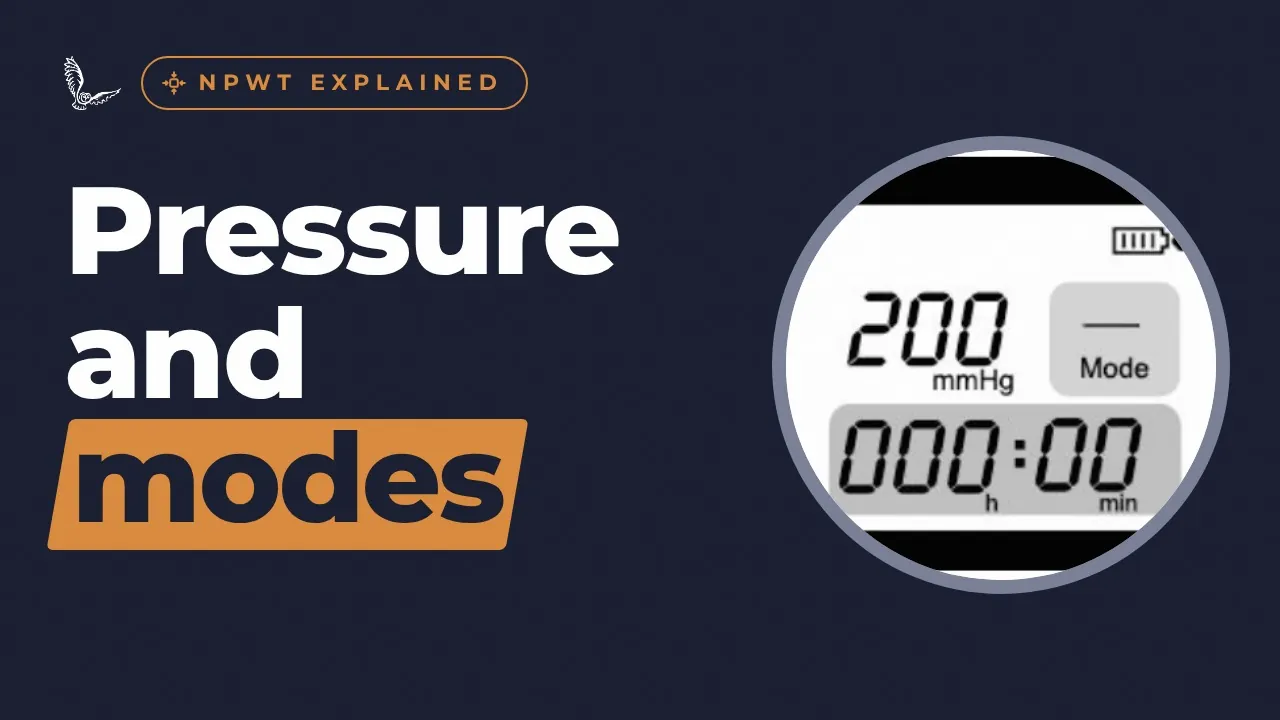
What NPWT pressure settings mean, the Aluco Guardian™ range, settings commonly used for open wounds and grafts, and the difference between continuous and intermittent modes, with the published evidence. For vet teams.
Three things to remember
- The Guardian's range is fifty to two hundred millimetres of mercury.
- Continuous is the default.
- Grafts and stitched edges usually get a lower setting.
The full episode, written out
This is the narration from the video, so you can read it at your own pace, share it, or come back to a section.
Introduction
Welcome to Aluco Health. I'm Georgie Hollis. This is NPWT Explained. Today: pressure and modes. What do the numbers mean, and what do teams usually set?
Two settings
When you start NPWT, you set two things: how strong the suction is, and whether it runs steadily or switches on and off. So what do the numbers mean, and what do teams usually use?
Jargon buster
Suction is measured in millimetres of mercury, written mmHg. NPWT works a little below normal air pressure. One hundred and twenty-five millimetres of mercury below normal is about a sixth of normal air pressure.
The range
On the Aluco Guardian, you can set the pressure anywhere from fifty to two hundred millimetres of mercury, in steps of five. The user manual says typical veterinary therapy is one hundred to one hundred and fifty, and that the choice is the clinician's.
Common settings
What do teams usually use? The quick user guide gives one hundred and twenty-five, continuous, as typical use, with clinical judgement. The application guide suggests about one hundred and twenty for open wounds, and eighty to ninety over grafts and stitched edges. In the forty-five-dog study, foam dressings were run at one hundred and twenty-five. Over grafts, the authors used eighty millimetres of mercury, with a non-stick layer under the dressing. And in one of our case reports, the team used eighty to ninety after a flap.
Continuous or intermittent
Now the mode. Continuous is the default: steady suction, all the time, suitable for most wounds. Intermittent switches on for five minutes and off for two, and the user manual says it may encourage healing tissue. But in the forty-five-dog study, the authors found cats disliked on-off suction, flinching when the pump started, so they switched to continuous for cats.
Choosing
So how do you choose? Your vet weighs up the wound, the animal and the seal. One specialist in our case reports describes one hundred and twenty-five as standard for contaminated or infected wounds. Gentler settings are used over grafts: an experimental graft study used sixty-five, then lower. Whatever you choose, the foam should collapse and wrinkle, which shows the suction is reaching the wound.
On screen
Here's the screen in two of our cases. Once you're happy with the settings, lock the screen, so nobody changes them by accident.
Myth or fact?
A common belief is that more suction must be better. Not necessarily. The aim is a steady seal and fluid removal, without harming fragile tissue, so grafts and fresh stitch lines often get a lower setting. Your vet decides.
Words explained
- mmHg
- Millimetres of mercury, the unit for suction strength.
- Continuous mode
- Steady suction all the time.
- Intermittent mode
- Suction that switches on and off.
Sources
- S1Aluco Health. ALUCO GUARDIAN™ user manual: simplified and improved version.
- S2Aluco Health. Aluco Guardian™ Negative Pressure Therapy System user manual / instructions for use, version 1, December 2024.
- S3Aluco Health. Aluco Guardian™ user guide for trained clinical staff, December 2025.
- S4Aluco Health. Aluco Guardian™ user guide: step-by-step application (presentation).
- S5Pitt KA, Stanley BJ. Negative pressure wound therapy: experience in 45 dogs. Vet Surg 2014;43(4):380–387. doi:10.1111/j.1532-950X.2014.12155.x pmc.ncbi.nlm.nih.gov/articles/PMC5026415
- S6Aluco Health. Case study 005: Necrotising fasciitis. Case provided by Nick Bacon, Aura Veterinary. Approved; published on alucohealth.com.
- S7Aluco Health. Case study 003: Greyhound with pancarpal arthrodesis wound breakdown. Case provided by Lisa Telford RVN, Edinburgh Veterinary School. Approved; published on alucohealth.com.
- S8Stanley BJ, Pitt KA, Weder CD, et al. Effects of negative pressure wound therapy on healing of free full-thickness skin grafts in dogs. Vet Surg 2013;42(5):511–522. pmc.ncbi.nlm.nih.gov/articles/PMC3671389
- S9Aluco Health. ALUCO GUARDIAN™ negative pressure wound therapy system: quick start guide (2 pages).
General information about animal wound care, not veterinary advice. Always follow your vet's advice. Aluco Guardian™ is for use by veterinary professionals. Evidence mentioned is not specific to Aluco Guardian™ unless we say so.
See the Aluco Guardian™ in your practice
Hire one for a single case, try it with a demonstration, or buy for a regular caseload. Training and round-the-clock clinical support for vet teams come with it.
Ask your vet whether NPWT could help
Your vet knows your pet best. Take your questions to them, or send them this page.
Watch next
 5:38
1 Dec
What is NPWT? Negative pressure wound therapy in animals
 1:59
1 Dec
 3:23
1 Dec
 2:31
1 Dec